Jussi Tuorin philatelic journey: from childhood hobby to historical masterpieces
Stamp collecting was a widespread hobby during Jussi Tuori's childhood, with nearly every young boy collecting stamps. Groups of boys would run from one antique shop to another, hunting for valuable finds, often with a focus on geography. For Jussi, this meant collecting stamps from Finland and the British Commonwealth.
At age seven, Jussi received a batch of Finnish stamps from his father as a gift, along with a Lape album, a stamp catalog, tweezers, and mounts. He spent his pocket money on stamps and exchanged stamps with friends to grow his collection. By his teenage years, Jussi had built a respectable Finnish collection, though it later gathered dust as studies, career, and family life took priority.

Born in Helsinki in 1940, Jussi graduated from the University of Helsinki in 1964 with a degree in applied mathematics and began a long career with Kansallis-Osake-Pankki (KOP). In the mid-1970s, Jussi rediscovered his childhood collection and started to think about what he could do with it. He was recommended Mikko Ossa’s book Finland: A Treasury of Philately, and after reading it, he realized it wouldn’t be impossible to complete his collection with missing stamps, like large and small pearl ovals. Already, he had one cut 10 kopeck oval in his collection. Jussi also saw that acquiring different perforations of the large-toothed stamps from 1860–1866 was within reach. From that point on, he was hooked.
KOP’s stamp club as a key networking hub
A stroke of luck was that Jussi’s workplace, Kansallis-Osake-Pankki, had its own active stamp club with several prominent Finnish philatelists as members, including Björn-Eric Saarinen, Kari Rahiala, and Kaarlo Hirvikoski. Jussi was recruited into the club, with Kari Rahiala as his mentor, and in 1979, he joined the Swedish-speaking philatelist association in Helsinki (HFF), Finland’s oldest stamp club. Through Kari, Jussi met several other influential philatelists who became key contacts and mentors in his philatelic career. Besides Rahiala, Jussi’s closest philatelic friends have been Kaj Hellman and Jorma Leinonen. According to Jussi, he wouldn’t have progressed in philately without them.
Jussi believes that social connections are essential in the hobby. When enthusiasts gather, backgrounds don’t matter; everyone is on equal footing, united by shared interests. Socializing is also a significant aspect of club activities, which Jussi values, along with organized and international engagement. His involvement has spanned student politics, chairing the Finnish Student Union (SYL), health care, information technology, Finnish-Soviet scientific cooperation, philately, and finance organizations. His international contacts have brought many lifelong friends.

The role of history
An interest in history runs through almost all of Jussi’s collections, especially in his Winning the Independence collection, which combined historical content with relevant philatelic rarities, like sketches of the Saarinen model. His collections of revenue stamps are also rich in historical documents. Historically based collections require extensive research, as do his current interests in revenue-stamped documents, which demand deep investigation.
Focusing on specific interests
As his collections grew, Jussi learned that he couldn’t collect everything, so he focused on Finnish philately. As a young boy, he had collected stamps from the British Commonwealth, but as an adult, he limited his collection to specific areas of Finland. Starting with classic Finland, he built a solid collection. Today, he primarily focuses on revenue stamps, stamped papers, and postal stationery, having traversed various branches of philately. According to Jussi, he moved from traditional philately to postal history and stationery before finally focusing on revenue stamps.

Multiple exhibition collections
Jussi’s first major exhibition collection was Classic Finland 1856–1884, which he describes as his “fifth child.” The collection required years of dedication and financial sacrifice, but in 1990, he was awarded a large gold medal at the international exhibition in London, his most significant philatelic achievement for a long time.
This collection was followed by many other high-quality collections, all focused on Finnish philately, except one—his Danish collection from 1851–1869. The classic portion, from 1851–1863, earned two large international gold medals and a Nordic Grand Prix. To fund new collections, he later sold this and other collections.
In addition to a classic Finnish collection, he has built collections of various definitive series, including the Saarinen model, Lion models from 1930 and 1954, postal stationery collections based on the Saarinen model, Vaasa model, and the 1930 Lion model, as well as revenue stamp collections of large-toothed stamps from 1865–1866, stamps from 1881–1894, and extra-stamped paper. His Winning the Independence collection has been widely used to promote philately to the public. His most personal collection is a one-frame display of his great-grandfather’s clerical career. Now he aims to build three more collections, including one focused on the Vaasa model, before his 90th birthday.

Acquiring materials and knowledge
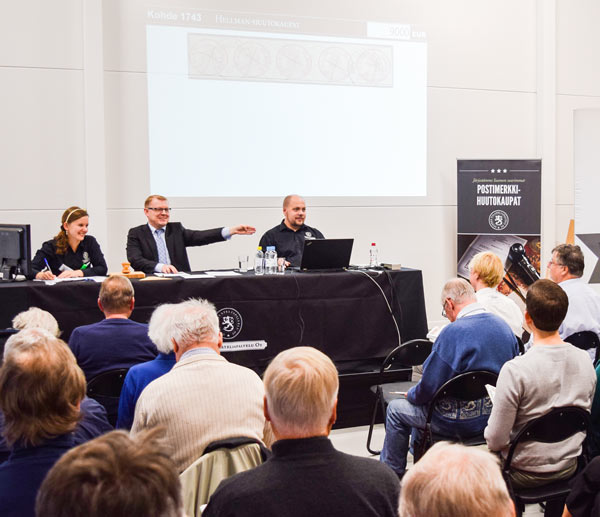
Jussi’s exhibition collections began with acquiring materials, primarily through auctions. For Finnish items, purchasing entire collections has also been essential, transferring substantial knowledge and expertise. Jussi has been dealing with Hellman Auctions for fifty years, building a relationship of trust. Kaj Hellman, whom Jussi considered deeply honest, sold his auction house to Tatu Untinen, and Jussi found that despite their differences, the two shared core values of honesty, creativity, and flexibility.

The power of crowdfunding
Jussi’s close friend Kaj Hellman spent years working on a biography of Finland’s iconic philatelist Agathon Fabergé (1876–1951) with Scottish author Jeffrey Stone. A distinctive feature of their research was Fabergé’s thousands of handwritten pencil marks on the back of stamps, still recognized today as ex Fabergé. Aware of his terminal illness, Kaj worked tirelessly to complete the project, aiming to publish it at the Finlandia 2017 exhibition, but he passed away before its completion. Jeffrey Stone continued Kaj’s work, with Jussi securing funding and a publisher to finish it.
Crowdfunding was new at the time, but Jussi persuaded various parties to contribute €1,000 each, appealing to the philatelic significance of the book and the memory of Kaj Hellman. Eight domestic and eight international contributors helped bring the project to life. The Finnish Philatelic Service, the parent company of Hellman Auctions, published the book in Finland’s centenary year, fulfilling Kaj’s wish.
Read the full article in issue 3/2024 of Keräilyuutiset. You can purchase a single issue from our online store at stamps.fi